Nestoo Worksphere vs Traditional Office Space: Complete Cost Analysis for Basaveshwara Nagar Businesses
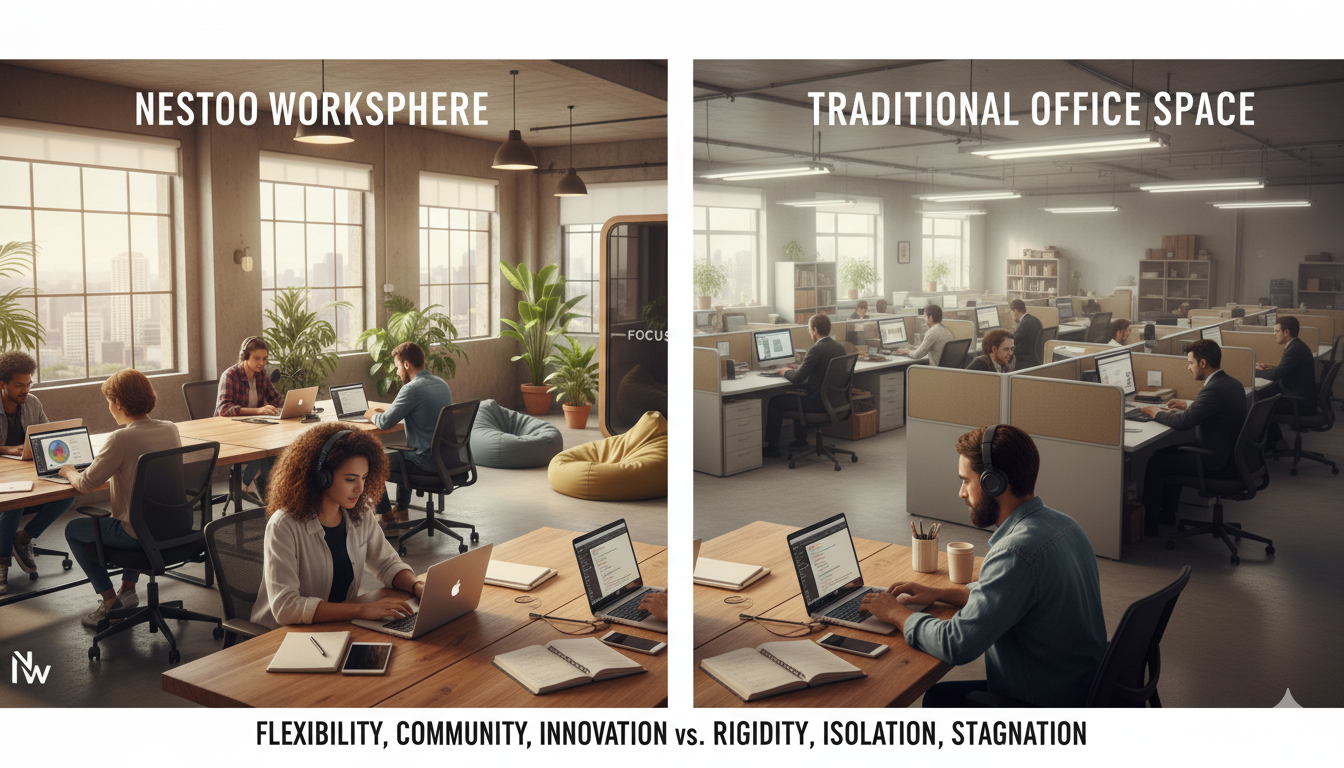
Choosing where your team works is one of the biggest cost decisions a business in Bangalore will make. Traditional office leases bring rent, deposits, fit-out bills, furniture, utilities and maintenance — all of which add up quickly. Coworking at Nestoo Worksphere in Basaveshwara Nagar provides an office space alternative that bundles amenities, flexibility and professional services into a predictable monthly fee. Below is a compact, realistic cost comparison and a simple ROI example you can read in 3–4 minutes.
Commercial rents in Basaveshwara Nagar vary by location and quality, but current listings show market rents at roughly ₹25–₹30 per sq. ft. per month for local office spaces a useful baseline when estimating traditional office costs.
Beyond monthly rent, an often-overlooked cost is fit-out: ceilings, flooring, workstations, meeting rooms and basic services. For a mid-range finish in Indian cities, fit-out costs are commonly in the ₹1,200–₹1,800 per sq. ft. range (JLL and industry guides put mid-spec fit-outs squarely in this band), so the one-time setup bill is significant. (JLL)
By contrast, coworking fees in Bangalore for dedicated desks and private cabins vary, but common ranges are ₹4,000–₹16,000 per person per month depending on the plan and location — which includes utilities, internet, meeting rooms, cleaning, security and basic office furniture. These published price bands make monthly costs predictable and largely operational rather than capital-intensive. (myhq)
A simple example (realistic, transparent assumptions)
Assume a10-person team needs roughly 1,000 sq. ft. of space:
Traditional office (sample numbers): rent at ₹27/sq.ft → ₹27,000/month (₹3,24,000/year). Mid-range fit-out at ₹1,500/sq.ft → ₹15,00,000 one-time. First-year total (rent + fit-out) ≈ ₹18,24,000. (This excludes variable deposits, furniture buyouts, recurring utilities and maintenance which increase costs further.) (MagicBricks)
Coworking (sample numbers): dedicated desk at ₹8,000/person/month → ₹80,000/month (₹9,60,000/year). This includes meeting rooms, business address/virtual office basics, utilities and cleaning no fit-out or furniture purchase required. (myhq)
Result(first year): Nestoo Worksphere–style coworking: ₹9.6L vs traditional setup: ₹18.24L → ~47% lower first-year cost in this scenario, mainly because coworking eliminates the one-time fit-out and capital expenditure. Your mileage will vary with exact rent, fit-out spec and coworking plan, but the pattern is consistent. (Over subsequent years the ongoing savings narrow to the difference between recurring rent + maintenance vs coworking membership fees.) (Numbers rounded for clarity; see sources above.)
Why many Bangalore businesses choose flexible workspace
Multiple market analyses show coworking can be substantially cheaper than full office leases once you account for fit-out, deposits, furniture and services — reports commonly estimate cost advantages in the range of ~25–50%, and in some scenarios (small teams avoiding heavy capex) even higher. Coworking also removes long lease lock-ins, which improves cash flow and ROI for growing teams. (Coworking Cafe)
What to factor into your ROI decision
If you’re comparing Nestoo Worksphere to a traditional lease, look beyond headline rent: include one-time fit-out, furniture replacement, security deposit/locking capital, utility bills, cleaning, reception, meeting-room availability and time spent managing vendors. Coworking converts many of these into an all-in monthly operating expense so you can redeploy capital to hiring, product development or marketing — which often yields higher ROI than spending it on space. (The Economic Times)
Bottom line
For startups, small teams and businesses that value flexibility, coworking at Nestoo Worksphere in Basaveshwara Nagar is a compelling office space alternative that often delivers large first-year savings (by avoiding fit-out and upfront capital) and more predictable monthly costs. For larger, fully established firms with specific compliance or branding needs, a traditional lease may still make sense; run the numbers with the assumptions above to see which model gives you faster ROI.